


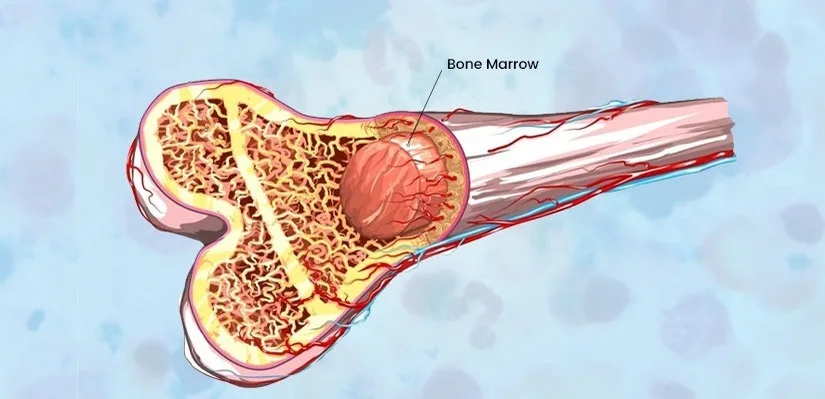
Bone marrow transplantation is one of modern medicine’s most powerful treatment methods for hematological cancers and genetically inherited blood disorders.
This procedure involves replacing bone marrow that has lost its function or is filled with diseased cells with healthy stem cells to restart the body’s blood production mechanism.
What is Bone Marrow Transplantation (Stem Cell Transplantation)?
Commonly known as “bone marrow transplant,” this procedure is referred to as Hematopoietic Stem Cell Transplant in medical literature. Contrary to popular belief, it is not a surgical tissue transplant (like kidney or liver transplant); it is the process of administering healthy stem cells to the patient through the bloodstream.
The Role and Importance of Stem Cells in the Body
Stem cells are unspecialized cells that are the “raw material” of our body. The primary function of hematopoietic stem cells, which are located in the bone marrow, is to transform into three main blood cells that are critical for the continuity of life:
Erythrocytes (Red Blood Cells): Transport oxygen to tissues.
Leukocytes (White Blood Cells): These are the immune system’s soldiers that protect the body against infection.
Platelets: Stop bleeding by enabling blood clotting.
Why is a Bone Marrow Transplant Performed?
The primary goal of bone marrow transplantation is to eliminate diseased bone marrow and replace it with a healthy, functional immune system. This treatment is generally sought for two main reasons:
Bone Marrow Failure: Conditions in which the marrow cannot produce enough blood cells.
Malignant Diseases: Conditions where the bone marrow is invaded by cancer cells or where these cells need to be eliminated with high-dose chemotherapy.
[Diagram/Visual Need: The Differentiation Process of Stem Cells and Their Transformation into Blood Cells]
In Which Diseases Is Bone Marrow Transplantation Performed?
The decision to perform a transplant is made based on the patient’s age, general health, and genetic risk factors for the disease.
Diseases Treated with Allogeneic Stem Cell Transplantation
Allogeneic transplantation is a method that uses cells obtained from a healthy donor. It is generally the primary treatment option for the following diseases:
Acute Leukemias (AML, ALL): Especially in high-risk or relapsed cases.
Myelodysplastic Syndrome (MDS): “Pre-leukemia” conditions in which the bone marrow produces defective cells.
Severe Aplastic Anemia: Conditions where the bone marrow is completely depleted.
Chronic Leukemias: CML cases resistant to drug therapy.
Diseases Treated with Autologous Stem Cell Transplantation
This method involves freezing and storing the patient’s own healthy cells and re-administering them after high-dose chemotherapy:
Multiple Myeloma: The standard treatment protocol for plasma cell cancer of the bone marrow.
Hodgkin and Non-Hodgkin Lymphoma: Applied when the disease recurs or is resistant to standard treatments.
Certain Solid Tumors: Specific types of cancer requiring high-dose drug therapy.
Bone Marrow Transplantation in Children and Pediatric Applications
Pediatric transplant processes, unlike those for adults, also cover genetic and metabolic diseases. According to Prof. Dr. Erdinç Özek, transplantation in childhood is not only a cancer treatment but also a solution for chronic diseases that will last a lifetime:
Thalassemia (Mediterranean Anemia) and Sickle Cell Anemia: For the definitive treatment of genetic blood disorders.
Immune Deficiencies: Conditions where the immune system is congenitally deficient.
Metabolic Disorders: Certain congenital enzyme deficiencies (e.g., Adrenoleukodystrophy, etc.).
| Disease Group | Transplant Type Preference | Primary Goal |
| Acute Leukemia | Generally Allogeneic | To completely replace the diseased bone marrow |
| Multiple Myeloma | Usually Autologous | To salvage the bone marrow after high-dose therapy |
| Mediterranean Anemia | Always allogeneic | Ensuring blood production with a healthy genetic structure |
Prof. Dr. Erdinç Özek: “Bone marrow transplantation is directly related to timing. Transplants performed during the ‘remission’ period, when the disease cell load is at its lowest, have a much higher chance of success compared to resistant diseases. Therefore, transplantation should be seen not as a ‘last resort’ in the treatment process, but as a strategic ‘step towards recovery’.”
What Are the Types of Stem Cell Transplantation?
In modern hematology, transplant types are categorized based on the source of the stem cells and the patient’s needs. Prof. Dr. Erdinç Özek states that the principle of “personalized treatment” is the most critical factor in minimizing the risk of complications when choosing the type of transplant.
Autologous Transplantation: Treatment with the Patient’s Own Cells
In autologous transplantation, the patient is both the donor and the recipient. The main goal of this method is to compensate for the permanent damage that very high doses of chemotherapy will cause to the bone marrow in order to eliminate the disease.
Process: The patient’s healthy stem cells are collected, frozen, and returned to the patient after high-dose treatment.
Advantage: There is no tissue compatibility issue and no risk of “Graft Versus Host” (tissue rejection).
Allogeneic Transplantation: Treatment with Cells Obtained from a Donor
This involves transplanting stem cells obtained from another person. Tissue compatibility (HLA) is the most important criterion in this method.
Fully Compatible Relative: These are usually transplants from siblings.
Fully Compatible Non-Relative: These are voluntary donors found through bone marrow banks (such as TÜRKÖK).
Clinical Effect: The donor’s immune cells have the capacity to recognize and destroy cancer cells in the patient’s body as “foreign” (Graft Versus Tumor effect).
Haploidentical Transplant: Transplant from a Half-Matching Family Member
When a fully matched donor cannot be found, the transplant is performed using a mother, father, child, or half-matched sibling. Thanks to the “T-cell manipulation” techniques developed in recent years, success rates have approached those of fully matched transplants. It is of vital importance in cases requiring urgent transplantation, as it eliminates the donor waiting period.
Cord Blood Transplantation: Treatment Using Placenta and Umbilical Cord Sources
This involves the use of stem cells obtained from the umbilical cord blood of newborn babies. Because the cells are “pure and immature,” transplant success can be achieved even if tissue compatibility is not perfect. However, when the number of cells is limited, it is generally preferred for pediatric patients or underweight adults.
How Are Stem Cells Collected? (Donor Process)
The stem cell collection process is performed in centers with the highest sterilization standards, without putting the donor’s health at risk.
Peripheral Blood Stem Cell Collection (Apheresis Method)
This is the most commonly used method today. The stem cells in the donor’s bone marrow are released into the bloodstream (peripheral blood) through “growth factor” injections administered over 4-5 days.
Procedure: The donor is connected to an apheresis machine. Blood is drawn from one arm, and after the machine separates the stem cells, the remaining blood is returned to the donor through the other arm.
Comfort: No anesthesia is required, and the donor can return to daily life immediately.
Cell Collection via Bone Marrow (Operating Room Conditions)
In some specific blood disorders (e.g., aplastic anemia), direct collection from the bone marrow may be preferred.
Procedure: Performed in an operating room environment under general or local anesthesia. Marrow is aspirated from the back of the hip bone (pelvis) using special needles.
Process: The donor is usually discharged after being observed overnight.
Stem Cell Donor Requirements and Age Limit
Being a donor requires both ethical and medical responsibility.
Age Limit: The standard age range for volunteer donors is 18-50 (may be extended to 55 depending on the center).
Health Criteria: Healthy individuals with no infectious diseases (hepatitis, HIV, etc.), chronic organ failure, or active cancer history can be donors.
Assurance: Stem cell donation does not reduce the number of cells in the donor’s body; the body replenishes these cells within a short period.
Prof. Dr. Erdinç Özek: “Beliefs such as ‘paralysis during bone marrow extraction’ or ‘weakening of the body’, which are the biggest concerns of potential donors, have no medical basis. The procedure performed using the apheresis method does not impose a permanent burden on the donor, except that it takes a little longer than a blood donation.”
Treatment Options Comparison Table
| Feature | Autologous Transplant | Allogeneic Transplant | Haploidentical Transplant |
| Cell Source | The patient themselves | Fully matched donor | Half-matched relative |
| Risk of Tissue Rejection | None | Present (Controllable) | High (Special treatment required) |
| Recovery Rate | Faster | Moderate | Requires more careful monitoring |
| Primary Goal | High-dose chemotherapy support | A new immune system | Meeting the urgent need for donors |
The Bone Marrow Transplant Process and Stages
Bone marrow transplantation is not a single procedure, but a meticulous process that takes weeks. Prof. Dr. Erdinç Özek emphasizes that the success of this process depends not only on the patient’s physical preparation, but also on the proactive follow-up of the clinical team at every stage.
Pre-Transplant Preparation and Catheter Placement
Once the decision to transplant has been made, the patient undergoes a thorough examination, including heart, lung, kidney, and dental health. For the comfort of the process, a central venous catheter (central line) is placed in the main vein in the neck or chest area by a surgeon.
Why is it necessary? All chemotherapy, antibiotics, blood products, and transplanted stem cells are administered to the patient through this line without damaging the blood vessels.
Preparation Regimen: High-Dose Chemotherapy and Radiotherapy
This phase, also known as “conditioning,” covers the 5-10 days immediately preceding the transplant.
Purpose: To completely destroy diseased cells and “make room” in the bone marrow for the new stem cells.
Application: Depending on the type of disease, either high-dose chemotherapy alone or chemotherapy combined with total body irradiation (TBI) is administered.
Transplant Procedure: Transfer of Stem Cells to the Patient
The day after the conditioning regimen ends is considered “day zero” (Day 0). Stem cells are administered to the patient through a previously inserted catheter, using a method similar to a blood transfusion.
Duration: The procedure usually takes 1-2 hours. The cells embark on a journey through the circulatory system to find and settle in the bone marrow beds.
Engraftment Period: New Cells Begin to Function
It usually takes 10 to 21 days for the cells to settle in the bone marrow and start producing blood. This critical waiting period is called engraftment.
Sign: Success is confirmed by observing a steady increase in the patient’s blood counts (especially neutrophils and platelets).
Post-Transplant Follow-Up and Potential Issues
The post-transplant period is when the new immune system is “introduced” to the body. Close monitoring during this phase is vital for the early diagnosis of possible complications.
What is Graft Versus Host Disease (GVHD)?
It is a condition seen only in allogeneic (donor-derived) transplants. It occurs when the transplanted donor cells (graft) perceive the patient’s own tissues (host) as “foreign” and attack them.
Acute GVHD: Within the first 100 days, it can affect the skin (rash), liver (jaundice), and intestines (diarrhea).
Chronic GVHD: May occur later on and involve dry mouth, skin hardening, and lung problems. It is managed with immunosuppressive drugs.
Early and Late Complications After Transplantation
Infections: Viral, bacterial, and fungal infections pose the greatest risk when the immune system is still weak.
Organ Damage: Temporary impairments in liver (VOD/SOS) or kidney function may occur as a side effect of chemotherapy.
Late Period: Cataract development or hormonal changes (such as infertility) are conditions monitored in the long term.
Home Care and Infection Prevention Methods
The first 100 days after discharge from the hospital are the “golden period.”
Hygiene: Dust-collecting items (such as carpets) should be minimized at home, and the environment should be regularly ventilated.
Nutrition: Avoid undercooked meat, food sold in open markets, and poorly washed vegetables (low microbial diet).
Visitor Restrictions: Avoid crowded environments and continue to wear a mask.
Frequently Asked Questions
Is Bone Marrow Transplantation Covered by Insurance? (SGK Coverage)
In Turkey, bone marrow transplantation is a treatment covered by the Social Security Institution (SGK). Many foundations and private hospitals have special agreements with SGK for this treatment. Additional fees may vary depending on the patient’s condition and the selected center; it is best to consult with the finance department of the relevant center for more information.
When Can You Return to Daily Life and Exercise After the Transplant?
Generally, light walking can be started between 3 and 6 months after the transplant. A full return to work and intense physical activity can occur at the end of the first year, once the immune system has fully recovered, with the doctor’s approval.
How Long Does It Take for Bone Marrow to Regenerate?
Although it takes 2-3 weeks for the transplanted cells to start producing blood, it can take 6-12 months for the immune system to function at full capacity (at a level that protects against disease) in autologous transplants, and 1-2 years in allogeneic transplants.
Prof. Dr. Erdinç Özek: “Discharge is not an end, but a new beginning. Your diligence at home and adherence to medication are the biggest factors in cementing the success of our efforts at the hospital. If your temperature reaches 38 degrees, don’t wait until morning; contact our team immediately.”
Scientific References
The following authorities’ current protocols and publications were referenced in preparing this content:
European Society for Blood and Marrow Transplantation (EBMT) Handbook.
The Lancet Haematology – Advances in Allogeneic Hematopoietic Cell Transplantation.
PubMed: Recent trends in haploidentical stem cell transplantation (2025).
Expert Opinion and Appointment
Bone marrow transplantation and stem cell therapy is a highly specialized process that must be personalized according to each patient’s genetic makeup and the stage of their disease. To obtain more detailed information about treatment options, types of transplants, and process management, you can schedule an appointment with Prof. Dr. Erdinç Özek and begin your clinical evaluation process.