


Joint pain and cartilage damage are serious health problems that directly affect quality of life and limit freedom of movement.
Regenerative medicine, one of the most advanced areas of modern medicine, offers non-surgical solutions to these problems by utilizing the body’s own repair potential.
What is Stem Cell Therapy? (Non-Surgical Joint Repair)
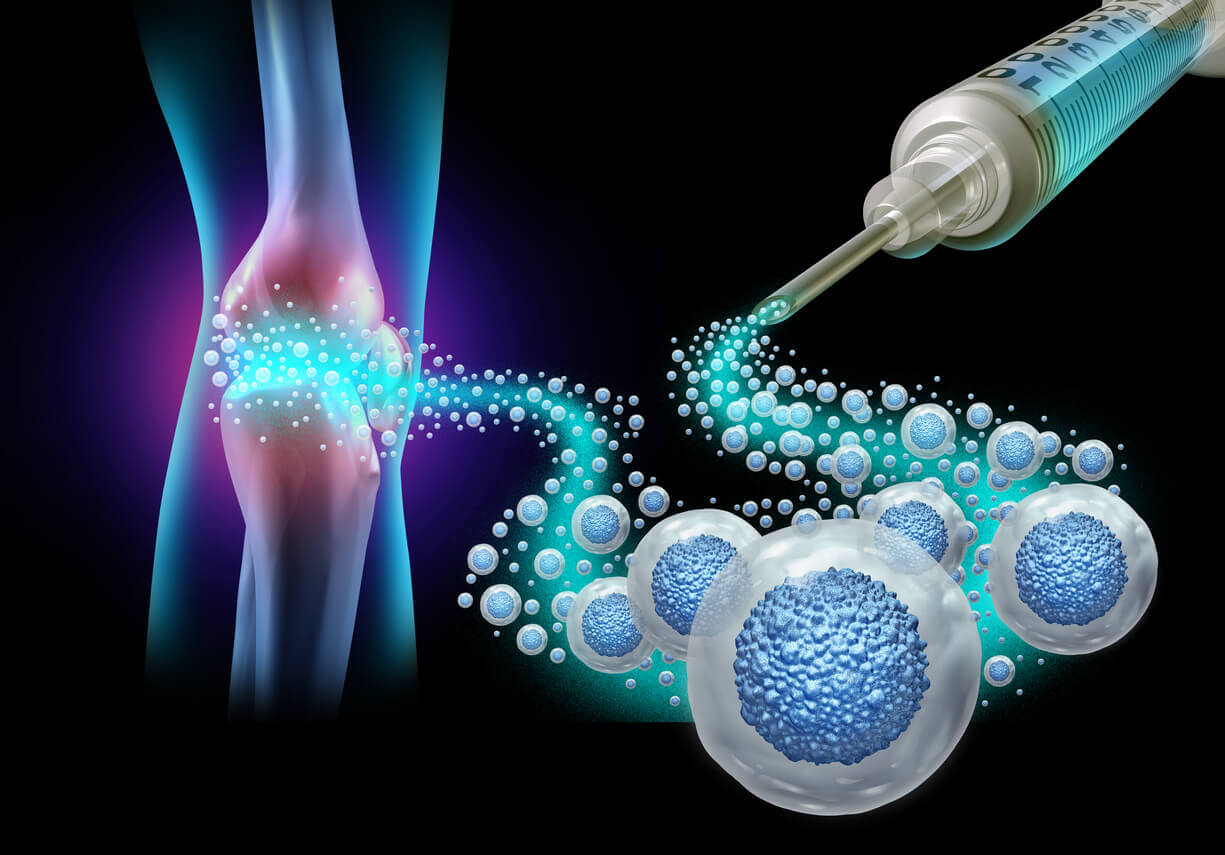
Stem cell therapy is the process of concentrating the primary cells in our body that have the ability to repair tissue and transferring them to the damaged area. This method aims to initiate a cellular-level healing process in the damaged area, rather than simply masking the pain.
How Stem Cells Work: Regenerative Medicine and Tissue Repair
The transplanted stem cells work within the joint’s microenvironment through two primary mechanisms:
Homing: The injected cells adhere directly to the damaged area by following chemical signals released from the site of tissue damage.
Biochemical Factory Effect: Cells secrete anti-inflammatory cytokines and growth factors, stopping the destruction within the joint and encouraging the proliferation of healthy cells.
Why Stem Cells? The Last Resort Before Surgery and Its Advantages
Stem cell therapy is the gold standard, especially for the patient group described as “too young for a prosthesis, too late for physical therapy.”
Biological Compatibility: Since the patient’s own cells (autologous) are used, there is no risk of rejection or allergy.
Quick Recovery: No general anesthesia is required, and the patient can return home the same day.
Wide Range: It can be applied not only to the knee but also to many small and large joints in the body.
In Which Joint Diseases Is Stem Cell Therapy Used?
The success of the treatment varies depending on the stage of the disease and the characteristics of the area to be treated. Unlike competitors, it focuses not only on calcification but also on tissue death and tears.
Stem Cells for Knee Osteoarthritis (Arthrosis) and Meniscus Tears
It is used in Grade 2 and Grade 3 osteoarthritis of the knee to increase the smoothness of the cartilage surface and repair micro-tears in the meniscus.
This reduces mechanical friction in the knee and increases pain-free range of motion.
Hip and Shoulder Cartilage Damage: Avascular Necrosis Solutions
In cases of avascular necrosis (AVN) caused by impaired blood supply in the hip joint, stem cells play a critical role in stopping tissue death.
In the shoulder, they provide regenerative support for cartilage wear associated with chronic tendon tears and impingement syndromes.
Ankle, Elbow, and Wrist Joint Pain
They are preferred to restore tissue integrity in cartilage contusions (osteochondral lesions), tennis/golfer’s elbow, and wrist ligament injuries, especially in athletes.
Spinal and Disc Degeneration: A New Era in Back and Neck Health
Stem cell applications into worn and dehydrated intervertebral discs help restore the disc’s biomechanical strength, opening a new window in the management of herniated disc-related pain.
| Treatment Comparison | Cortisone Injection | Stem Cell Therapy | Joint Replacement (Surgery) |
| Objective | Temporary Pain Relief | Tissue Repair and Regeneration | Replacement of Damaged Joint |
| Recovery Period | 1-2 Days | 2-6 Weeks (Cellular Process) | 3-6 Months |
| Durability | Short-Term | Long-Term Effect | Permanent (For the Life of the Prosthesis) |
| Risk of Side Effects | Risk of Cartilage Damage | Minimal (Your Own Cells) | Infection and Surgical Risks |
Recommendation from Prof. Dr. Erdinç Özek: “The question our patients ask most often is ‘Will I recover immediately?’ Stem cell therapy is not a drug injection, but a biological seeding process. It takes time for these seeds to sprout and turn into tissue. Patience and proper rehabilitation are the keys to success.”
Stem Cell Sources: Where Are the Cells Obtained From?
Stem cells used in regenerative medicine are obtained from specific areas of the body known as its self-renewal reservoirs.
Today, the most reliable source within an ethical and legal framework is the patient’s own (autologous) adult stem cells.
Adipose Tissue-Derived (SVF) Stem Cells: The Power of the Abdomen
Recent scientific research has proven that adipose tissue from the abdominal area contains 500 to 2500 times more mesenchymal stem cells than bone marrow.
Stromal Vascular Fraction (SVF): Adipose tissue obtained through a minor liposuction procedure is processed through a special separation process to obtain a pure stem cell cocktail.
This method is the most powerful source, particularly preferred in older patients due to high cell viability and tissue abundance.
Bone Marrow Aspirate Concentrate (BMAC) Applications
This is the traditional method and the one with the most clinical studies. Bone marrow, usually obtained from the iliac crest using special needles, is spun at high speed (centrifuged) to produce a concentrate rich in healing cells.
The presence of both hematopoietic and mesenchymal cells provides a significant advantage in tissues with reduced blood supply (necrotic).
Differences Between Cell Culture and Centrifugation Methods
The process of preparing the cells directly affects the success of the treatment. There are two basic approaches:
Centrifuge (Same Day): Cells are collected from the body, concentrated within approximately 30-60 minutes, and transferred to the patient during the same session. It is fast and the risk of contamination is minimal.
Cell Culture (Laboratory): A small amount of cells collected is multiplied in special laboratories under GMP standards for 3-4 weeks. It is preferred in cases of extensive cartilage loss requiring billions of cells.
Treatment Process and Application Protocol
Treatment is not just a single injection; it requires meticulous preparation and application discipline.
Pre-Procedure Preparation: Who is a Suitable Candidate for This Treatment?
Not every patient is suitable for stem cell therapy. Ideal candidates are generally individuals who meet the following criteria:
Those with early and mid-stage (Grade 1-2-3) joint osteoarthritis.
Those who are at risk for surgery or wish to postpone prosthetic surgery.
Those with a body mass index (BMI) at a level that does not affect cell health.
Contraindications: This procedure is not performed on individuals with active infection, advanced rheumatic disease, or malignancy (tumor) in the treatment area.
Procedure Stages: Local Anesthesia and Minimally Invasive Method
The procedure is planned to maximize patient comfort:
Local Anesthesia: The area where cells will be harvested (lower back or abdomen) is numbed.
Sampling: Tissue samples are collected using minimally invasive techniques.
Separation: The cells are prepared in a closed-system centrifuge or enzymatic separation unit.
Transplantation: The prepared cells are injected directly into the damaged joint space under ultrasound or fluoroscopic guidance.
Transplants Supported by Biomaterials and Carrier (Scaffold/Matrix) Technology
In large cartilage defects, biological scaffolds called “scaffolds” are used to prevent the injected cells from dispersing due to gravity or joint movement.
These carriers (usually collagen or hyaluronic acid-based) enable the cells to adhere to the damaged area and establish a “nest” there to produce new tissue.
This technology contributes to the long-term success of the treatment by enhancing its mechanical durability.
| Feature | Laboratory Culture | Same-Day Application (SVF/BMAC) |
| Duration | 3 – 4 Weeks | 60 – 90 Minutes |
| Cell Count | Very High (Billions) | High (Millions) |
| Cost | High | Moderate |
| Hospitalization | May be necessary | Not required |
Recommendation from Prof. Dr. Erdinç Özek: “As important as the source of the cells is how they are processed and the technology used to place them into the joint. A correctly selected ‘carrier matrix’ can accelerate healing by up to 40% by preventing the cells from dispersing. Clinics with a solid scientific foundation never overlook these details.”
Post-Treatment Recovery and Success Conditions
Stem cell transplantation is only the beginning of a biological repair process. The complete integration of the injected cells into the target tissue (cartilage, meniscus, or tendon) and their ability to perform their function are strictly dependent on the protocols followed after the procedure.
The Effect of Physical Therapy and Rehabilitation on Cell Integration
Stem cells possess “mechanosensitive” properties; that is, they adapt to the movement and pressure in their surroundings.
Cell Guidance: Properly planned physical therapy sends a “cartilage tissue transformation” signal to the transplanted cells.
Circulation and Nutrition: Controlled movement is essential for the circulation of synovial fluid within the joint. In an immobile joint, it becomes difficult for stem cells to be nourished and adhere to the tissue.
Factors Affecting Success Rates: Age, Stage, and Lifestyle
The success of stem cell therapy is a multi-component equation:
Cell Quality: The patient’s overall health and metabolic age affect the “regenerative capacity” of the cells.
Weight Control: Every extra pound on the joint creates destructive mechanical pressure on the newly forming delicate cartilage cells.
Smoking and Nutrition: Smoking impairs microcirculation, preventing cells from receiving oxygen. An antioxidant-focused diet supports the process.
Ideal Timing: At Which Stage Is the Highest Efficacy Achieved?
The highest success rates of treatment are seen in Stage 2 and Stage 3 (early and middle stage) osteoarthritis.
In cases where the cartilage tissue is completely destroyed (Stage 4), stem cells aim to reduce pain and postpone surgery rather than reverse the damage. Therefore, it is vital to intervene before cartilage loss deepens.
Frequently Asked Questions
How long does it take for stem cell therapy to take effect?
Although the biological repair process begins immediately after the procedure, a noticeable reduction in pain and functional improvement is generally felt starting from the third month, and the full recovery process can take anywhere from 6 to 12 months.
Is hospitalization required after the treatment?
Since the procedure is performed under local anesthesia and using minimally invasive methods, hospitalization is not required; the patient can return home on foot the same day after resting for a few hours following the procedure.
How long does the effect of stem cells last?
Although the success rate varies depending on the patient’s age and the stage of damage to the joint, the biological repair achieved generally provides durability for 2 to 5 years, and in suitable cases, this period may be even longer.
Is there significant pain during the procedure?
Since the area where the cells are taken and the joint where the injection will be made are completely numbed with local anesthesia, no significant pain is felt during the procedure; afterwards, there may only be a slight feeling of fullness that lasts for a few days.
Can cells from someone else be used instead of my own cells?
The safest and most ethical method for joint treatment is to use cells taken from the patient’s own body (autologous cells); this completely eliminates the risk of tissue rejection or allergic reactions.
How many sessions are required?
Stem cell therapy is generally a single-session treatment; however, depending on the patient’s needs, the process can be enhanced in subsequent years with supportive PRP or similar biological injections.
| Criteria | Stem Cell Therapy | Standard Medication/Physical Therapy | Surgery (Prosthesis) |
| Mechanism of Action | Cellular Repair | Symptomatic Relief | Mechanical Change |
| Application Time | 60-90 Minutes | Weeks of Sessions | 2-4 Hours of Surgery |
| Return to Work | 1-3 Days | Immediately | 2-6 Months |
| Risk Profile | Very Low | Low | Moderate/High |
Prof. Dr. Erdinç Özek: “The first 3 weeks after stem cell therapy are the ‘golden period’. During this time, while protecting your joint from excessive strain, you should not neglect the low-resistance exercises recommended to you. Remember, we are planting the seed; it is your disciplined rehabilitation process that will make it sprout.”
Scientific References and Clinical Evidence
PubMed (SVF and Knee Cartilage Repair): https://pubmed.ncbi.nlm.nih.gov/31345447/
Journal of Orthopaedic Research (Mechanical Loading and Cell Differentiation): https://onlinelibrary.wiley.com/doi/full/10.1002/jor.24641
International Journal of Molecular Sciences (BMAC vs SVF Comparison): https://www.mdpi.com/1422-0067/20/12/3002
Case Analysis Summary (Anonymous): A 45-year-old non-professional tennis player presented with elbow and knee pain. An MRI revealed Grade 2 cartilage damage. Following SVF application and a 6-week “cell-friendly” rehabilitation protocol, the patient was able to return to pain-free sports activity by the 4th month.
For detailed information and to assess whether your condition is suitable for this treatment, you can schedule an appointment at our clinic in Ankara to consult with a specialist.