


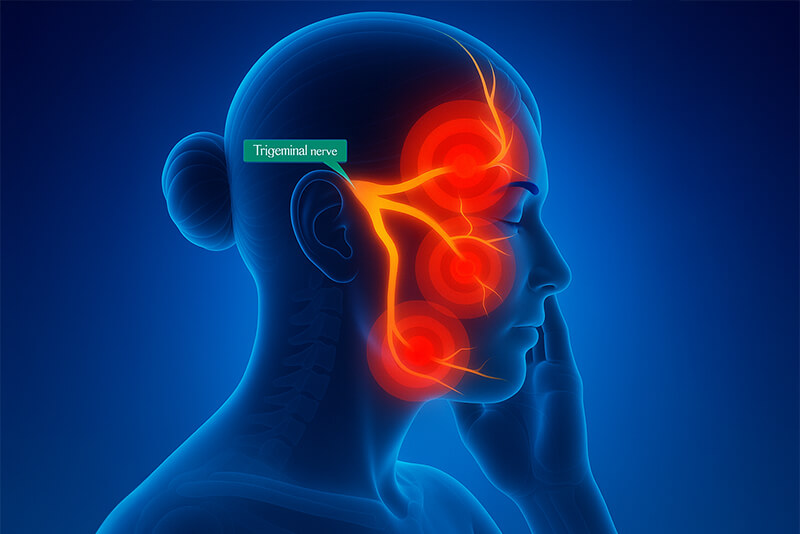
Trigeminal neuralgia is a chronic facial pain condition defined in the medical world as "one of the most severe pains" and significantly limits patients' quality of life. The reason it is known among the public by dramatic names such as "maddening disease" or "suicide disease" is because the pain occurs suddenly, with the intensity of a lightning strike or electric shock.
What is Trigeminal Neuralgia?
Trigeminal neuralgia takes its name from the "Trigeminal Nerve," the fifth cranial nerve that transmits facial sensation to the brain and controls the chewing muscles.
In this condition, the nerve transmits even light touches, which should not normally cause pain, to the brain as intense pain signals.
Anatomy of the Trigeminal Nerve and Pain Mechanism
After exiting the brain stem, the trigeminal nerve branches into three main divisions: the eye region (V1), the upper jaw (V2), and the lower jaw (V3).
Pain is usually concentrated in the cheek and jaw area where the V2 and V3 branches spread.
The basic mechanism of pain is damage to the protective sheath (myelin) at the point where the nerve enters the brain stem, causing a kind of "short circuit" between the nerve fibers.
Pain Triggers: Eating, Talking, and Touching
The most important feature that distinguishes trigeminal neuralgia from other types of facial pain is the trigger points. Patients often experience sudden attacks during the following activities:
Washing the face or light touch
Brushing teeth or shaving
Chewing food or drinking water
Exposure to wind or talking
Trigeminal Neuralgia Symptoms and Diagnosis Process
Accurate diagnosis is the most critical stage of treatment. Trigeminal neuralgia is often mistaken for toothache, which can lead to the extraction of healthy teeth.
Lightning Bolt-Like Facial Pain Characteristics
The pain usually occurs on only one side of the face. It comes in the form of attacks lasting from a few seconds to two minutes, causing a lightning bolt or electric shock sensation.
Between attacks, the patient may be completely pain-free but is constantly on alert for the next attack.
Diagnostic Methods: MRI (FIESTA/CISS) and Clinical Examination
Neurological examination is essential for diagnosis. However, standard brain MRIs may not be sufficient to determine the cause of the pain.
Special MRI techniques called FIESTA or CISS, which take millimeter-thick slices, are used. This method allows for the most detailed imaging of the relationship between the blood vessels and nerves in the brain stem.
Cases Confused with Toothache and Differential Diagnosis
Many patients visit the dentist before consulting a neurologist or neurosurgeon.
If the pain is triggered while eating but the dentist finds no structural problem with the teeth, the possibility of trigeminal neuralgia must be considered.
Misdiagnosis can lead to unnecessary root canal treatments or tooth loss.
What Causes Trigeminal Neuralgia?
The causes of the disease are usually related to physical pressure on the nerve.
Vascular Compression
In approximately 80-90% of cases, the cause is a normal artery near the brain stem coming into contact with the trigeminal nerve and beating against it with each heartbeat, wearing away its armor (myelin sheath).
Multiple Sclerosis (MS) and Other Neurological Causes
In trigeminal neuralgia seen in younger age groups, the possibility of Multiple Sclerosis (MS) should be investigated. MS can trigger this pain by directly affecting the nerve sheaths. Additionally, tumors or vascular anomalies in the skull base can also cause similar symptoms by compressing the nerve.
Trigeminal Neuralgia Treatment Options
The treatment algorithm typically progresses from the least invasive to the most effective option.
Medication and Side Effects
The first step in treatment is antiepileptic drugs. These drugs suppress pain by slowing nerve transmission.
However, over time, the body may develop resistance to the drug, or serious side effects such as dizziness, imbalance, and forgetfulness may occur at high doses.
When medications do not completely eliminate the pain, surgical options are considered.
Treatment Comparison Table
| Treatment Method | Duration of Effect | Administration Method | Primary Risk/Side Effect |
| Medication Treatment | Temporary (For control purposes) | Oral Administration | Dizziness, liver burden |
| Radiofrequency | Medium-Term (1-3 years) | Needle intervention | Permanent numbness in the face |
| Gamma Knife | Medium-term | Radiation | Delayed onset of pain (15-20% recurrence) |
| MVD Surgery | Long-Term (Permanent) | Microsurgery | Surgical risks (low rate) |
Gold Standard Surgery: Microvascular Decompression (MVD)
If the cause of the pain is vascular compression, the method that resolves the problem at its root is Microvascular Decompression (MVD) surgery.
How is MVD Surgery Performed? (Vessel and Nerve Separation)
A small incision of approximately 3-4 centimeters is made behind the ear to reach the area where the nerve enters the brain stem without damaging the brain tissue.
Under a microscope, the blood vessel compressing the nerve is carefully separated, and a protective cushion similar to "Teflon" is placed between them. This prevents the blood vessel from hitting the nerve.
Success Rate and Longevity of the Surgery
MVD is the only treatment method that does not damage the nerve. Other methods (such as radiofrequency) eliminate pain by burning or destroying the nerve, whereas MVD preserves the nerve's function.
The success rate is over 90%, and the risk of recurrence is much lower than with other methods.
Recommendations from Prof. Dr. Erdinç Özek
"The biggest mistake in trigeminal neuralgia treatment is enduring pain for years by indiscriminately increasing medication doses. When medications are insufficient or their side effects interfere with daily life, surgery is not an option, but rather a means of regaining quality of life. With the 'microvascular decompression' method in particular, our patients see their pain disappear immediately upon waking up. However, remember that the relationship between the nerve and the blood vessel must be very well analyzed on MRI before deciding on surgery."
Clinical Experiences and Anonymous Case Example
Case Analysis: A 52-year-old female patient presented to our clinic with right-sided facial pain that had persisted for 6 years. Despite taking 12 pills a day, she had lost 10 kilograms due to lightning-like pain triggered even by drinking water. Advanced CISS MRI examination revealed that the superior cerebellar artery was significantly compressing the trigeminal nerve. Following the microvascular decompression (MVD) surgery, the patient got off the operating table pain-free. At the 1-year follow-up, the patient's medications were discontinued, and no pain attacks recurred.
Recovery Process After Trigeminal Neuralgia Surgery
The postoperative process is generally quite comfortable for patients.
Duration of Pain Relief: Pain usually resolves immediately after MVD surgery. Some patients may experience mild aching for a few days, depending on the nerve's healing process.
Hospital Stay: Patients are usually discharged on the 2nd or 3rd day after surgery.
Social Life: After 10-15 days of rest at home, patients can return to their normal social and work lives. The stitches are cosmetic and usually do not need to be removed.
Trigeminal Neuralgia Specialist Appointment
If you experience severe facial pain, drug resistance, or recurrent trigeminal neuralgia attacks, you can schedule an appointment at our clinic to have your condition evaluated using microsurgical methods. You can request a professional opinion from Prof. Dr. Erdinç Özek with advanced MRI imaging techniques and personalized treatment planning. You can take the first step towards a pain-free life by consulting a specialist for detailed information and the examination process.
Scientific References
The Lancet: Trigeminal neuralgia: clinical review and treatment strategies. https://www.thelancet.com
Journal of Korean Neurosurgical Society (2022): Park CK et al. “Surgical Treatment for Trigeminal Neuralgia”. https://pubmed.ncbi.nlm.nih.gov/35430788/
PubMed (NIH): Comparison of MVD and Gamma Knife surgery in facial pain. https://pubmed.ncbi.nlm.nih.gov